Barcelona is one of the best cycling cities in Europe — and the most rewarding way to explore it is by bike. With flat seafront paths, wide boulevards, and a growing network of safe lanes, the city offers some of the best bike routes in Barcelona for visitors who want to see more while moving at the perfect pace. You don’t need to be a confident cyclist to enjoy it — you just need to know where to go.
Why Explore Barcelona by Bike?
Barcelona’s layout works in your favor. The seafront is completely flat. The Eixample district — where most of Gaudí’s major buildings are — follows a regular grid with wide cycling lanes on the main avenues. Even the hillier routes (Montjuïc, Park Güell) are manageable on an e-bike.
The practical case for cycling is straightforward:
- You cover more ground. On a bike, you can visit the Sagrada Família in the morning, ride down to Barceloneta Beach for lunch, and explore the Gothic Quarter in the afternoon. On foot, that’s a full day of walking. On a bike, it’s a comfortable morning.
- You reach places public transport doesn’t. Some of Barcelona’s best spots — hidden plazas, street art, local markets — are in narrow streets that buses and metro lines skip entirely.
- You avoid the tourist bottlenecks. Barcelona’s most visited attractions get genuinely crowded. On a bike you can arrive early, move quickly between sites, and leave before the crowds build.
- It costs less than you’d think. A day’s bike rental from Bikes & Tours Barcelona costs a fraction of a hop-on hop-off bus pass — and you move faster, see more, and stop whenever you want.
Where to Rent a Bike in Barcelona
Before the routes, the practical question: where do you get your bike?
Bikes & Tours Barcelona offers city bikes and e-bikes with flexible rental periods — a few hours, a full day, or multiple days. We recommend:
- City bike for the flat routes: seafront, Eixample, Gothic Quarter, Poblenou, El Raval
- E-bike for routes with hills: Montjuïc, Park Güell, Tibidabo, Collserola
Book in advance during spring and summer — spring weekends sell out fastest, so book ahead if you have fixed dates.
Reserve your Barcelona bike before your trip →
The 10 Best Bike Routes in Barcelona
Not sure where to start? Pick by goal:
- 🏆 Best for first-timers: Routes 1 + 2 (seafront + Gaudí)
- 🏘️ Best local experience: Route 6 (Poblenou)
- 🌅 Best views: Route 4 or 9 (e-bike recommended)
- 🏛️ Best old city: Route 3 (walk some sections)
Barcelona Bike Route 1: Barcelona Seafront — Barceloneta to the Forum
Distance: 8 km one way
Difficulty: Easy
Best time: Early morning or late afternoon
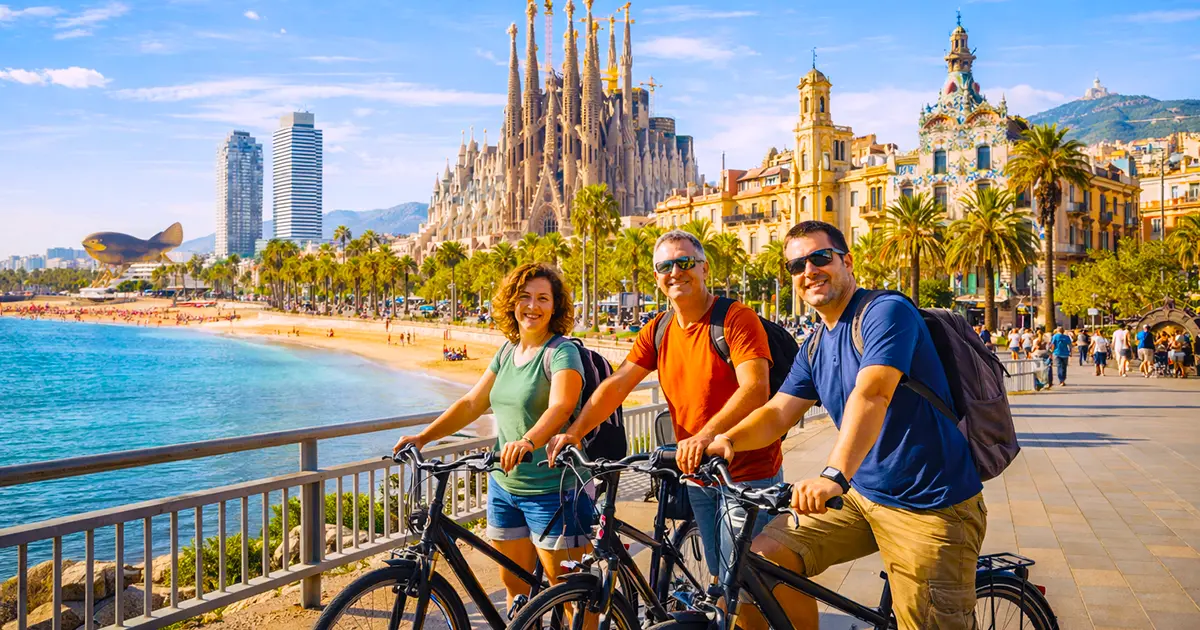
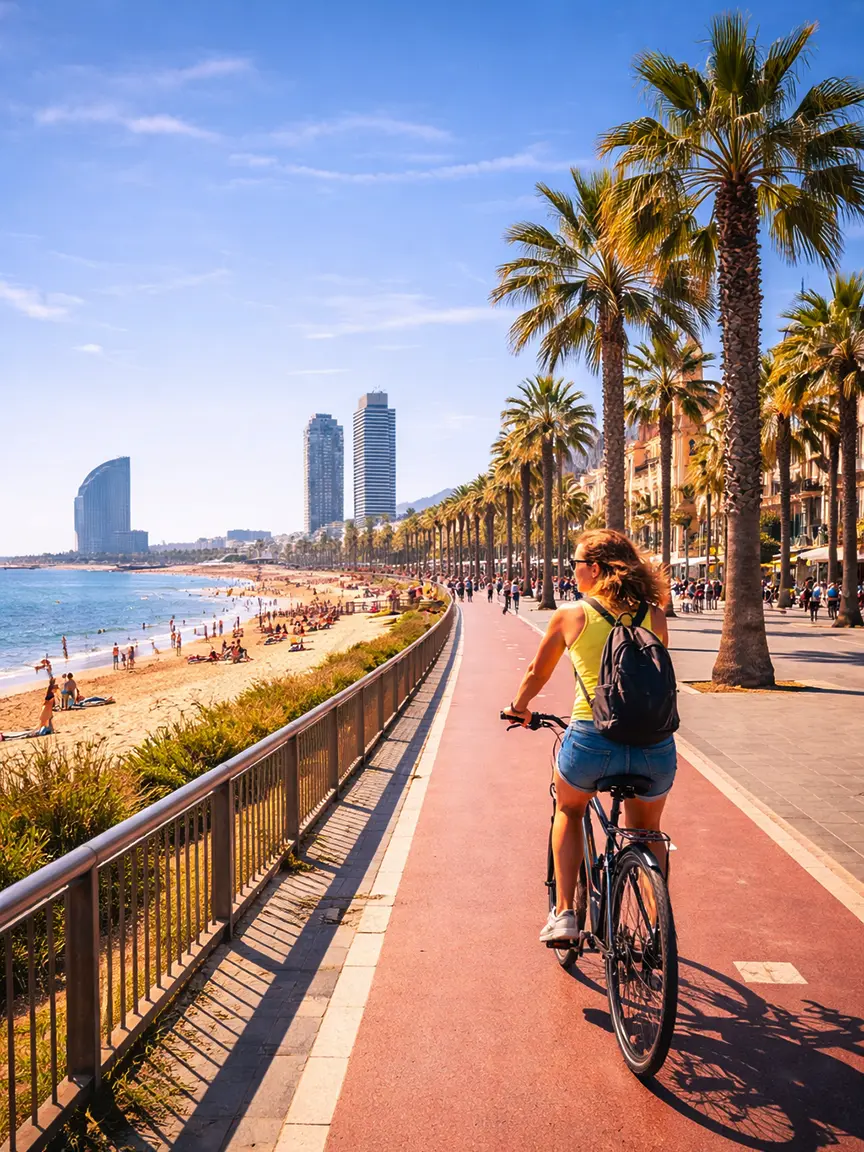
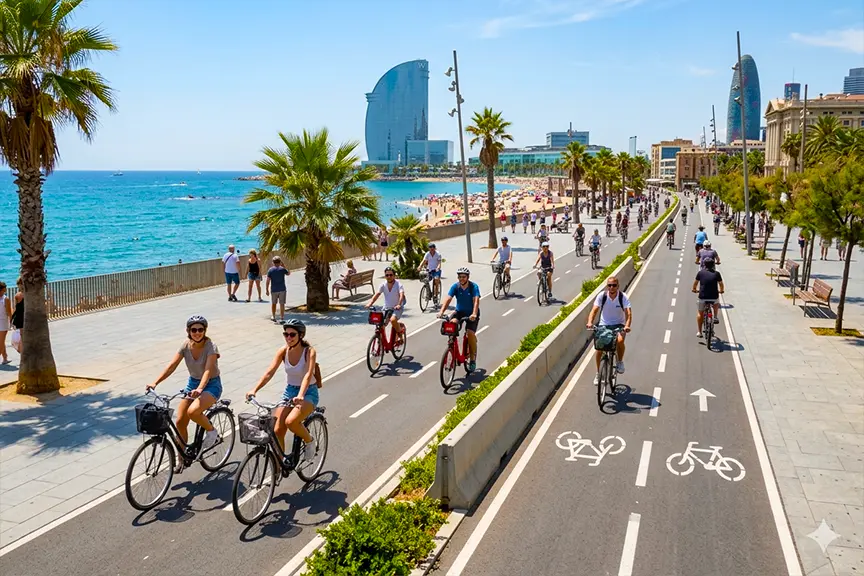
The seafront cycling path is the first ride every visitor to Barcelona should do. It’s completely flat, clearly marked, and runs along the entire waterfront from the old fishing neighborhood of Barceloneta north to the modern Forum district — 8 kilometers of Mediterranean views with almost no car traffic.
Barceloneta is the obvious starting point. The neighborhood has a distinct character — narrow grid streets, laundry hanging between balconies, seafood restaurants that have been serving the same dishes for decades. The beach stretches for over a kilometer, lined with chiringuitos (beach bars) that open from mid-morning.
Port Olímpic sits about halfway along the route, built for the 1992 Barcelona Olympics. The twin towers of Hotel Arts and Torre Mapfre mark the marina entrance, and Frank Gehry’s large golden fish sculpture — the Peix d’Or — catches the light throughout the day. A good spot to stop for coffee before continuing north.
Diagonal Mar and the Forum at the northern end feel like a different city — modern, open, and much quieter than the Barceloneta end. The views back toward the city from here are worth stopping for.
Tip: Ride north in the morning when the light is behind you. Return south in the late afternoon when the sun drops toward the city and the colors change completely.
Barcelona Bike Route 2: Passeig de Gràcia and the Gaudí Circuit
Distance: 6 km
Difficulty: Easy
Best time: Before 10am
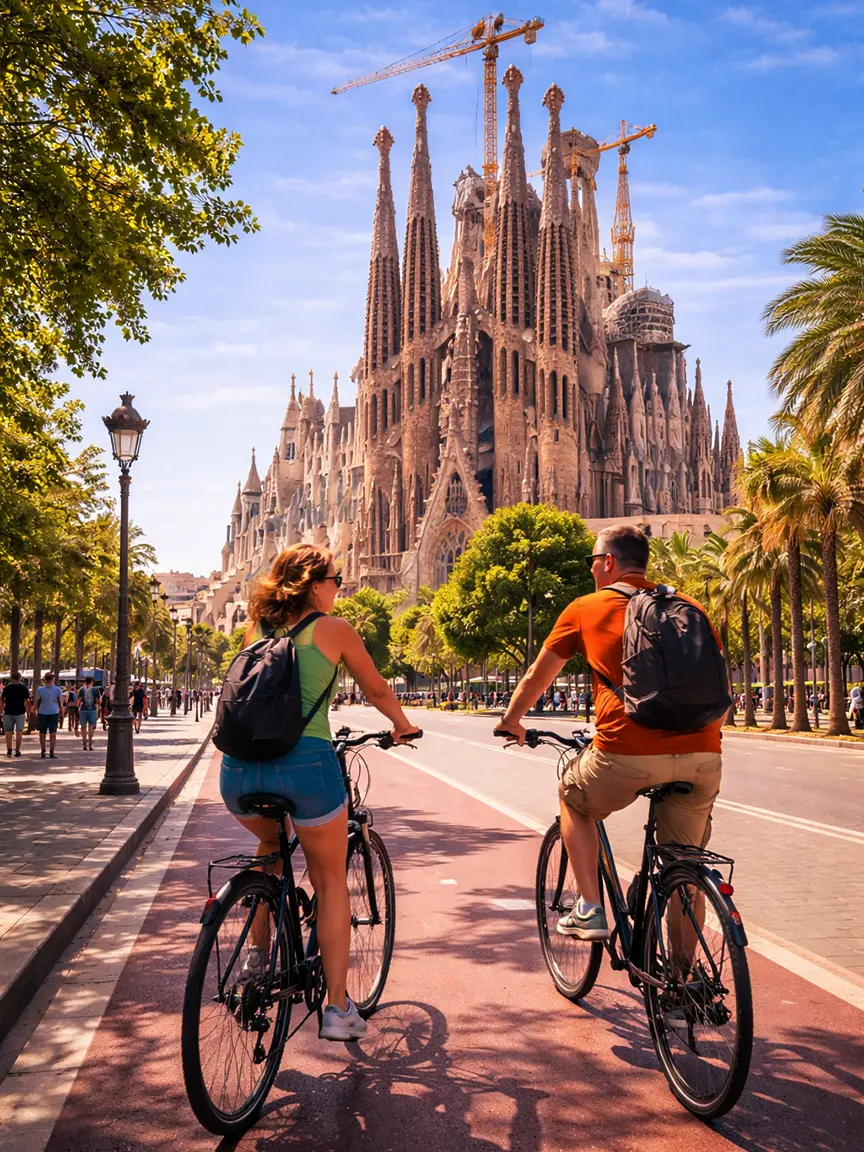
Passeig de Gràcia is Barcelona’s main Modernista boulevard — wide, tree-lined, with a dedicated cycling lane and three of the city’s most celebrated buildings within a few hundred meters of each other.
The Manzana de la Discordia (Block of Discord) at numbers 35–43 brings three competing architects — Gaudí, Puig i Cadafalch, and Domènech i Montaner — onto the same block. The result is a genuinely strange and wonderful stretch of street where every building is trying to outdo its neighbors.
- Casa Batlló (no. 43): Gaudí’s remodel of an existing building into something that looks simultaneously like a dragon’s back, an underwater cave, and a bone structure. The facade tiles shift from blue to green depending on where you’re standing.
- Casa Amatller (no. 41): Dutch Gothic stepped gable in terracotta and ceramics — a deliberate counterpoint to Gaudí’s organic forms next door.
- Casa Lleó Morera (no. 35): Domènech i Montaner’s contribution, the most ornate of the three.
Sagrada Família is a 10-minute ride east from Passeig de Gràcia. Lock your bike at one of the dedicated racks around the perimeter and walk around the exterior before deciding whether to go in. The Nativity facade (east side) and the Passion facade (west side) are completely different in style and mood — both worth seeing regardless of whether you have tickets.
Tip: Sagrada Família tickets sell out weeks in advance. Book online before your trip if you want to go inside.
Barcelona Bike Route 3: Gothic Quarter and El Born
Distance: 4 km
Difficulty: Easy to moderate (cobblestones)
Best time: Morning
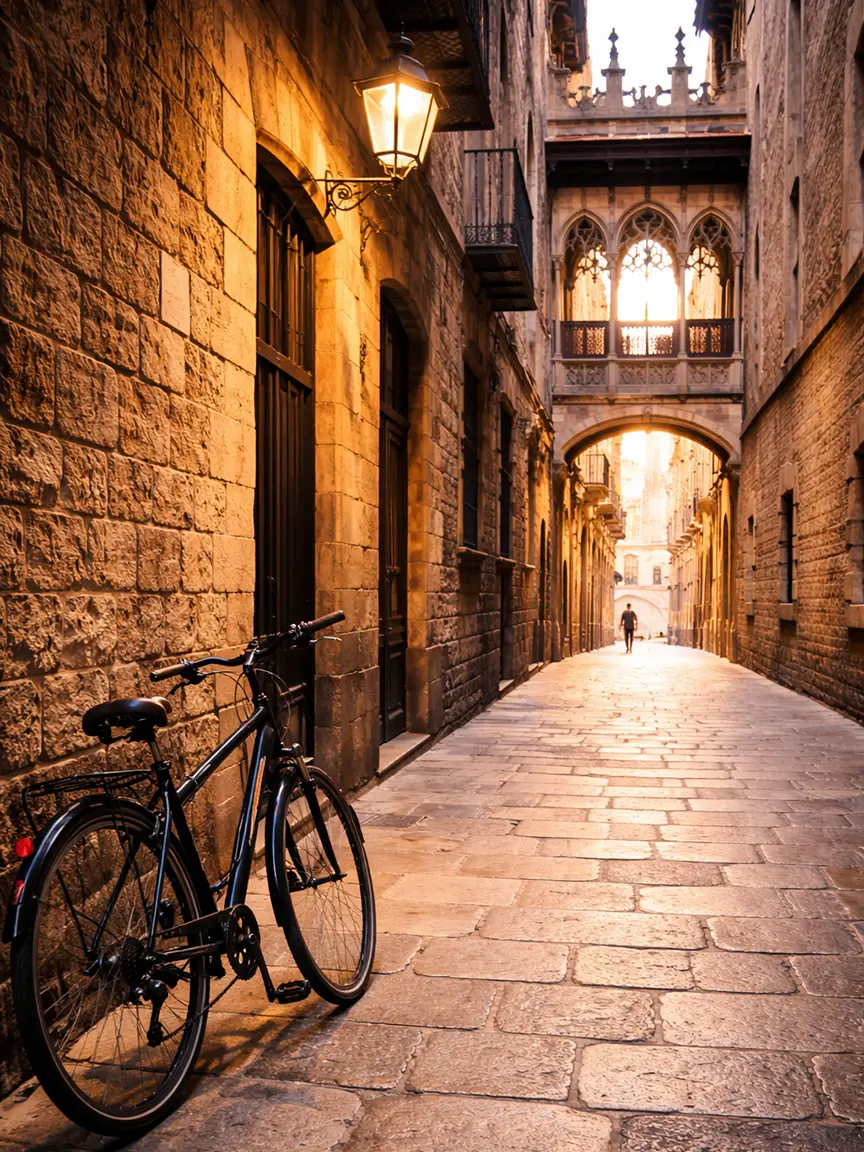
The Gothic Quarter (Barri Gòtic) is Barcelona’s medieval core — narrow streets, Roman walls, hidden plazas, and a cathedral that took 600 years to complete. Cycling here means going slowly and walking your bike through the tightest sections. That’s fine — the point is to look up, not to cover ground quickly.
Barcelona Cathedral anchors the neighborhood. The cloister behind the main entrance houses a flock of geese — a tradition dating back to the Middle Ages, when geese were kept here as a symbol of the cathedral’s patron saint. It’s one of those small, genuinely local details that most visitors walk straight past.
El Born sits just east of the Gothic Quarter and has become one of Barcelona’s most enjoyable neighborhoods for cycling and eating. The streets are narrow but manageable on a bike, and the density of good independent cafés, restaurants, and bars is higher here than almost anywhere else in the city.
Mercat de Santa Caterina — the neighborhood market — has an extraordinary mosaic-tiled roof designed by Enric Miralles that ripples and undulates like a wave. It’s the functional, local alternative to La Boqueria and worth visiting on that basis alone.
Tip: Walk your bike through the narrowest Gothic Quarter streets. Cycling them is technically possible but antisocial.
Barcelona Bike Route 4: Montjuïc by Bike
Distance: 8 km including ascent
Difficulty: Moderate
Best time: Late morning
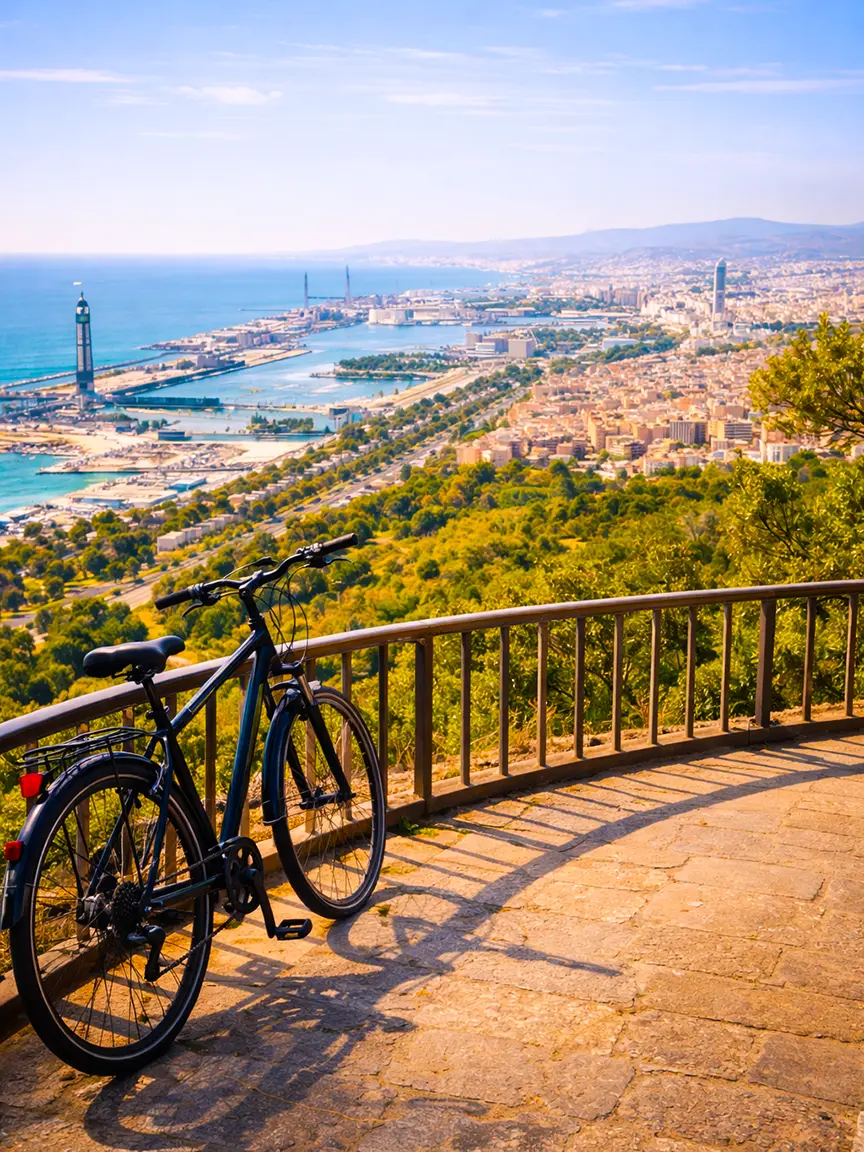
Montjuïc is the forested hill southwest of the city center, with views over the port and the Mediterranean that justify the climb on their own. The hill also contains an unusual concentration of cultural institutions — art museums, an Olympic stadium, sculpture gardens, and a 17th-century castle — connected by cycling paths through wooded parkland.
The ascent is the main consideration. It’s a real climb — around 170 meters of elevation over 3 kilometers. On a regular bike, it’s hard work but manageable if you’re reasonably fit. On an e-bike, it’s easy. Bikes & Tours Barcelona can advise on the best option for your fitness level.
What to see on Montjuïc:
- Jardins de Laribal — terraced gardens with fountains, pergolas, and quiet paths. Almost no tourists.
- MNAC (Museu Nacional d’Art de Catalunya) — the building itself is as impressive as anything inside, with views from the terrace across the entire city.
- Pavelló Mies van der Rohe — the 1929 German Pavilion, reconstructed in 1986. A pilgrimage site for anyone interested in architecture or design.
- Montjuïc Castle — 17th-century fortress at the summit, with 360-degree views that include the port, the city grid, and the sea.
Tip: Take the cable car (Telefèric de Montjuïc) up with your bike and cycle down. You get the views without the effort, and the descent through the gardens is genuinely enjoyable.
Barcelona Bike Route 5: Gràcia Neighbourhood and Park Güell
Distance: 5 km
Difficulty: Moderate (uphill to Park Güell)
Best time: Early morning
Gràcia was an independent town before Barcelona absorbed it in 1897, and it still feels that way. The neighborhood has its own mayor (honorary), its own festivals, and a strong local identity that resists the tourist pressure that has transformed other central neighborhoods.
Cycle through Gràcia’s plazas — Plaça del Sol, Plaça de la Vila de Gràcia, Plaça de la Virreina — and you’ll see the neighborhood at its most local: older residents playing cards, families having breakfast, teenagers cycling to school.
Park Güell sits on the Carmel Hill above Gràcia. Gaudí designed it as a private housing estate for developer Eusebi Güell; it ended up as a public park after the housing scheme failed. The monumental zone — with the Dragon Staircase, the Hypostyle Room, and the sinuous mosaic terrace — requires a timed ticket booked well in advance. The free zones around the perimeter are less visited and give you a more honest sense of the park’s scale.
Tip: Go early. The ticketed zone opens at 9:30am and the first hour is significantly quieter than anything that follows.
Barcelona Bike Route 6: Poblenou — Barcelona’s Creative District
Distance: 5 km
Difficulty: Easy
Best time: Any time
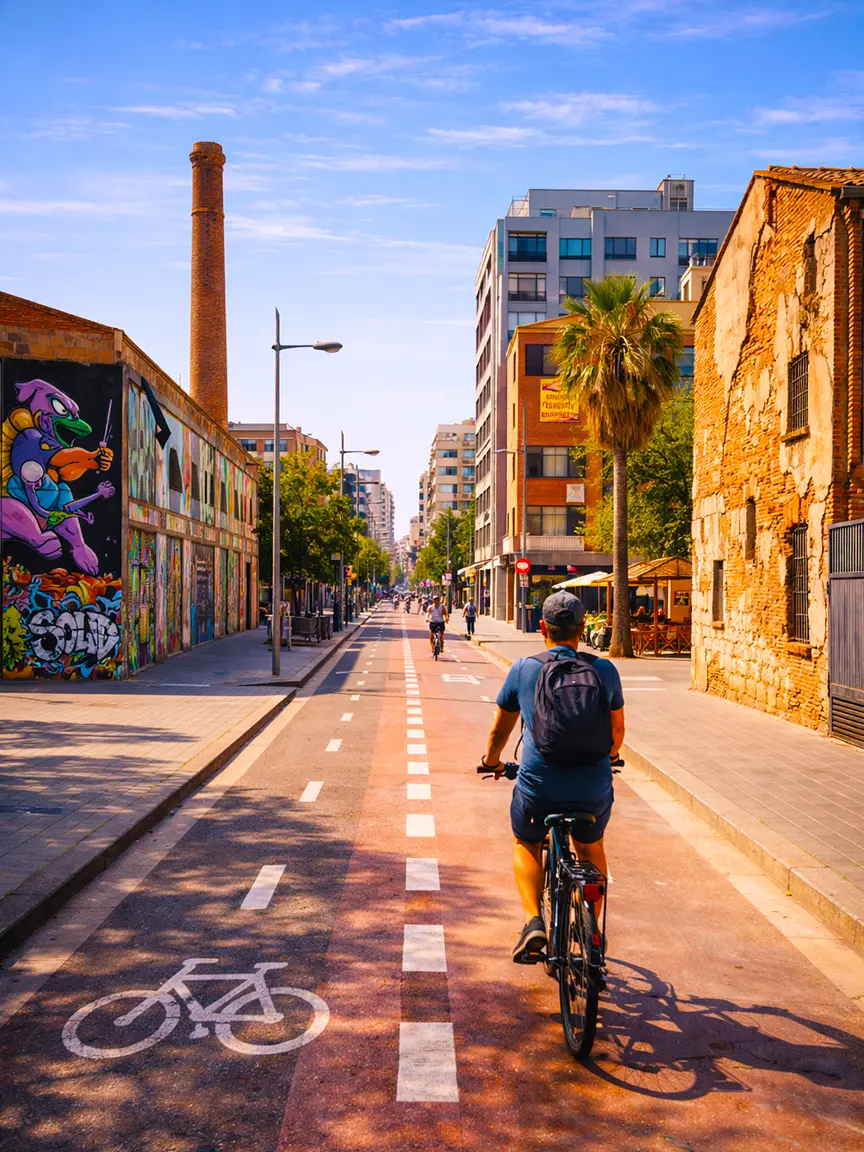
Poblenou is the neighborhood that best shows what Barcelona is becoming. A former industrial zone — factories, warehouses, rail yards — it has been systematically converted into a mixed district of tech offices, design studios, residential blocks, and some of the city’s most interesting independent food and drink businesses.
The streets are wide and flat, the cycling infrastructure is good, and the density of interesting things to look at — murals, converted factory facades, unexpected plazas — makes this one of the most rewarding neighborhoods to explore without a fixed plan.
Rambla del Poblenou is the neighborhood’s main street — a quieter, more local version of Las Ramblas with trees, terrace cafés, and almost no souvenir shops. The contrast with the city center Ramblas is striking.
Palo Alto Market (first weekend of every month) is held in a former factory complex and sells design, food, and craft from local producers. If your visit coincides with market weekend, it’s worth building your cycling route around it.
Tip: Combine Poblenou with the seafront route — they connect seamlessly, and together make a full half-day without retracing any ground.
Barcelona Bike Route 7: Avinguda Diagonal and Les Corts
Distance: 6 km
Difficulty: Easy
Best time: Morning
Avinguda Diagonal cuts across Barcelona’s grid at exactly 45 degrees — an 11-kilometer boulevard that connects the upscale residential neighborhoods in the west to the seafront in the east. The western section covered here passes through Les Corts and Sarrià, neighborhoods that most visitors never reach.
The cycling lane runs the length of the avenue and is wide enough to ride comfortably even when the boulevard is busy. The tree canopy provides shade in summer, and the relative absence of tourist crowds makes this a noticeably different experience from the city center routes.
Camp Nou — FC Barcelona’s stadium — sits just off Diagonal in Les Corts. Even without a match, the scale of the place is striking from outside. A new version is currently being built around the existing structure, which adds its own visual interest to the area.
Barcelona Bike Route 8: The Eixample Grid
Distance: Variable
Difficulty: Easy
Best time: Any time
The Eixample (Extension) district was designed by urban planner Ildefons Cerdà in the 1850s to expand the city beyond its medieval walls. His design — a regular grid of octagonal blocks, wide avenues, and chamfered corners that create small public spaces at every intersection — was radical at the time and remains one of the most recognizable urban patterns in the world when seen from above.
Cycling the Eixample grid requires no fixed plan. Pick a direction, follow the cycling lane, and turn when something looks interesting. The octagonal intersections mean you always have multiple options, and the density of good cafés, restaurants, and shops means you’re never far from a reason to stop.
Carrer d’Enric Granados deserves a specific mention: a pedestrianized boulevard with a cycling lane running its length, lined with outdoor terraces and populated almost entirely by locals. It’s the antidote to Passeig de Gràcia — same Eixample neighborhood, completely different atmosphere.
Barcelona Bike Route 9: Tibidabo and the Collserola Hills
Distance: 15 km including approach
Difficulty: Challenging
Best time: Morning
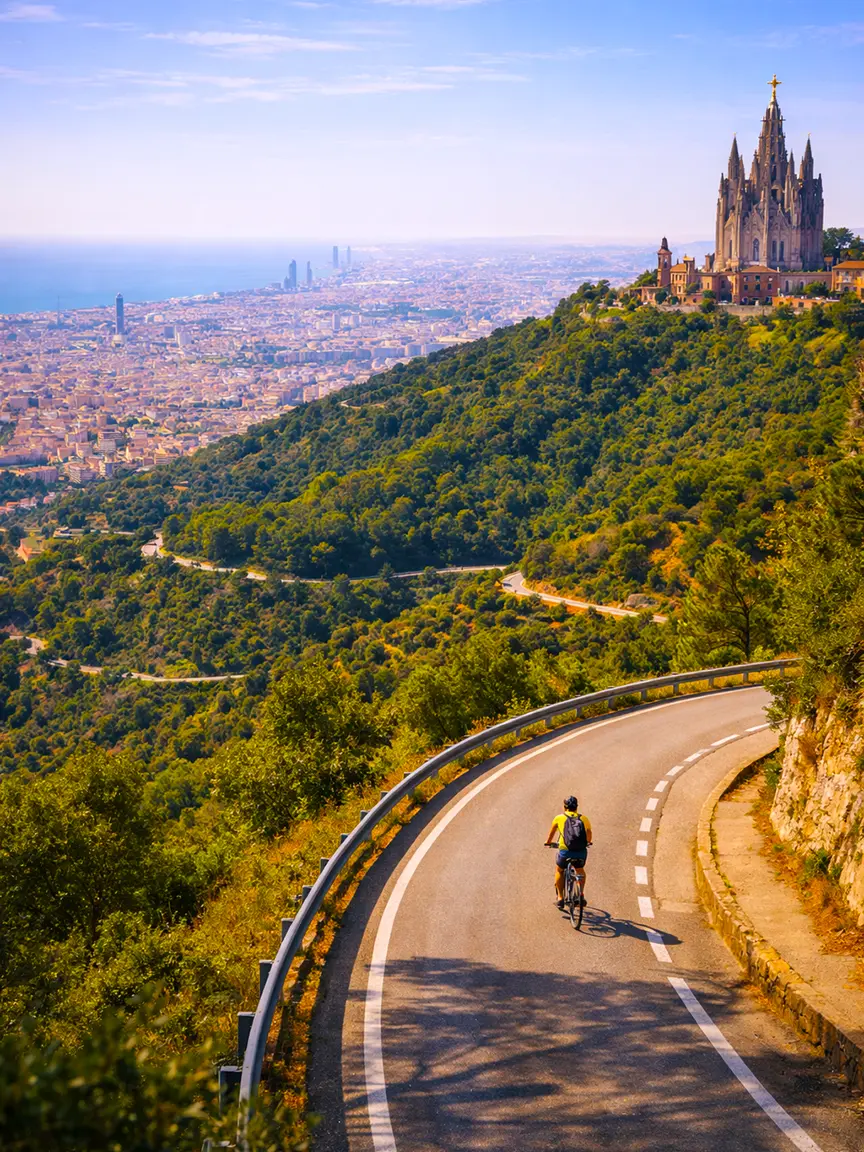
For cyclists who want elevation and views, the Collserola Natural Park — the forested ridge that forms Barcelona’s western backdrop — offers the most rewarding riding in the area. The Carretera de les Aigues, a flat path that traverses the hillside at around 400 meters of elevation, is popular with local cyclists and runners and gives continuous views across the city throughout its length.
The Tibidabo summit at 512 meters is the highest accessible point. The Tibidabo Amusement Park (opened 1901, one of the oldest in the world) and the Sagrat Cor church at the top create an unexpectedly fairytale quality to the views.
Tip: Best done on an e-bike. Contact us for advice on the right setup for this route.
Barcelona Bike Route 10: El Raval and Las Ramblas
Distance: 3 km
Difficulty: Easy
Best time: Morning
El Raval sits on the west side of Las Ramblas — a dense, multicultural neighborhood that has changed faster than almost anywhere else in Barcelona over the past two decades. The MACBA contemporary art museum and the CCCB cultural center anchor the upper part of the neighborhood; the streets below are more mixed, more local, and more interesting to cycle through.
Las Ramblas now has a continuous cycling lane along most of its length, running from Plaça de Catalunya down to the Columbus Monument at the waterfront. Cycling the Ramblas is a different experience from walking it — you move at a pace that lets you take in the flower stalls, street performers, and terrace cafés without being absorbed into the pedestrian crowd.
La Boqueria (Mercat de Sant Josep) is on Las Ramblas. The market is genuinely extraordinary in its range and quality of produce — but go before 10am if you want to experience it at its most local rather than its most touristic.
Barcelona Bike Itinerary: How to Plan Your Time
Best Barcelona Bike Routes for 1 Day
If you have one day in Barcelona and want to see the most on a bike, this is the sequence that works best:
9:00–11:00 — Seafront cycling route (Route 1) from Barceloneta to Port Olímpic and back. Flat, scenic, and the best possible introduction to the city.
11:00–13:00 — Ride up to Passeig de Gràcia (Route 2) to see Casa Batlló, the Manzana de la Discordia, and cycle around the Sagrada Família exterior.
14:30–17:30 — Explore the Gothic Quarter and El Born on foot and by bike (Route 3). Stop at Mercat de Santa Caterina and the Cathedral cloister.
17:30–19:00 — Return via the Eixample grid (Route 8), stopping on Carrer d’Enric Granados for a drink on a terrace before returning your bike.
This covers around 20km of cycling and gives you the Gaudí highlights, the old city, and the seafront in a single day.
Best Barcelona Bike Routes for 2 Days
With two days, you can add the neighborhoods and hills that most visitors miss.
Day 1: Follow the 1-day itinerary above.
Day 2 — Morning (9am–12pm): Gràcia and Park Güell (Route 5). Go early for the monumental zone — tickets for the 9:30am slot are the easiest to enjoy without crowds.
Day 2 — Afternoon (1pm–4pm): Poblenou cycling route (Route 6), connected directly to the seafront path. Quieter streets, street art, good coffee.
Day 2 — Late afternoon (4pm–6pm): Montjuïc by bike (Route 4) — take the cable car up, cycle down through the gardens and past the MNAC terrace for the best view of the city.
Two days on a bike in Barcelona covers more ground than most visitors see in four days on foot.
💡 Also cycling in Valencia? Our Valencia bike tours and bike rental in Valencia are run from the same team — with routes through the Turia Gardens, Albufera Natural Park, and the city’s historic center.
Practical Guide: Cycling in Barcelona
Safety and Rules of the Road
A few things worth knowing before you ride:
Bike lanes vs. pavements. Barcelona is actively fining cyclists who ride on pavements in central areas. Use the dedicated cycling lanes — they cover virtually every route in this guide.
Helmets. Not legally required for adults, but recommended. Always provided on request when you rent from Bikes & Tours Barcelona.
Locking your bike. Use a quality U-lock or D-lock. Lock through the frame and to fixed infrastructure — bollards, bike racks, metal railings. Cable locks are not sufficient in central Barcelona.
Traffic lights. Red means stop — for cyclists as much as for cars. Traffic enforcement in Barcelona has increased significantly and cyclists are included.
Las Ramblas pedestrian priority zones. Some sections of Las Ramblas and the Gothic Quarter have designated pedestrian-priority areas where cycling speed should drop to walking pace. Follow the signage.
Best times to avoid crowds on the bike:
- Sagrada Família area: avoid 10am–1pm and 3pm–6pm
- Las Ramblas: best before 9am
- Gothic Quarter: manageable until around 11am, then gets congested on foot and by bike
Barcelona’s Cycling Infrastructure
Barcelona has over 200 kilometers of dedicated cycling lanes, with the network expanding annually. Key arteries:
- Seafront cycling path (flat, scenic, separated from traffic)
- Passeig de Gràcia and the main Eixample avenues
- Avinguda Diagonal (full length)
- Carrer d’Enric Granados (pedestrianized with cycling lane)
- Montjuïc park roads and Collserola paths
Best Season for Cycling in Barcelona
March to June and September to November offer the best conditions — warm but not hot, and less crowded than peak summer. July and August are manageable with early morning starts and a midday break. December to February is mild by northern European standards (12–16°C) and the city is significantly quieter.
Frequently Asked Questions About Cycling in Barcelona
Yes — particularly for first-time visitors. The flat seafront and Eixample grid make the city beginner-friendly, and the cycling infrastructure has improved significantly over the past decade.
Bikes & Tours Barcelona offers city bikes and e-bikes with flexible rental periods. Book in advance during busy periods — spring and summer availability fills up quickly.
A regular city bike works well for the flat routes (seafront, Eixample, Gothic Quarter, Poblenou). An e-bike is worth it if you want to include Montjuïc, Park Güell, or Tibidabo without the effort of the climbs.
Generally yes. The dedicated cycling infrastructure is well-developed and mostly separated from motor traffic.
Bicycles are permitted during off-peak hours: before 7am, 10am–4pm, and after 8pm on weekdays, and all day on weekends.
Prices vary depending on bike type and rental duration. Check current rates and availability at Bikes & Tours Barcelona.
Two full days covers the highlights comfortably. A third day lets you add the hillier routes (Montjuïc, Park Güell) at a more relaxed pace.
Helmets are not legally required for adults in Barcelona, but we always recommend wearing one. Available on request.
Ready to Ride Barcelona?
These 10 routes cover the full range of what Barcelona offers on two wheels — from the seafront to the hilltops, from Gaudí’s masterpieces to the neighborhoods that most visitors never reach. You don’t need to do all of them in one trip. Pick two or three that match your interests and your fitness level, and leave the rest for next time.
Bikes & Tours Barcelona has the bikes, the local knowledge, and the flexibility to make your Barcelona cycling experience work — whether that’s a casual morning on the seafront or a full two-day exploration of the city.
Reserve your Barcelona bike before your dates sell out →
Spring weekends fill up fastest — if you have fixed dates, book ahead.